
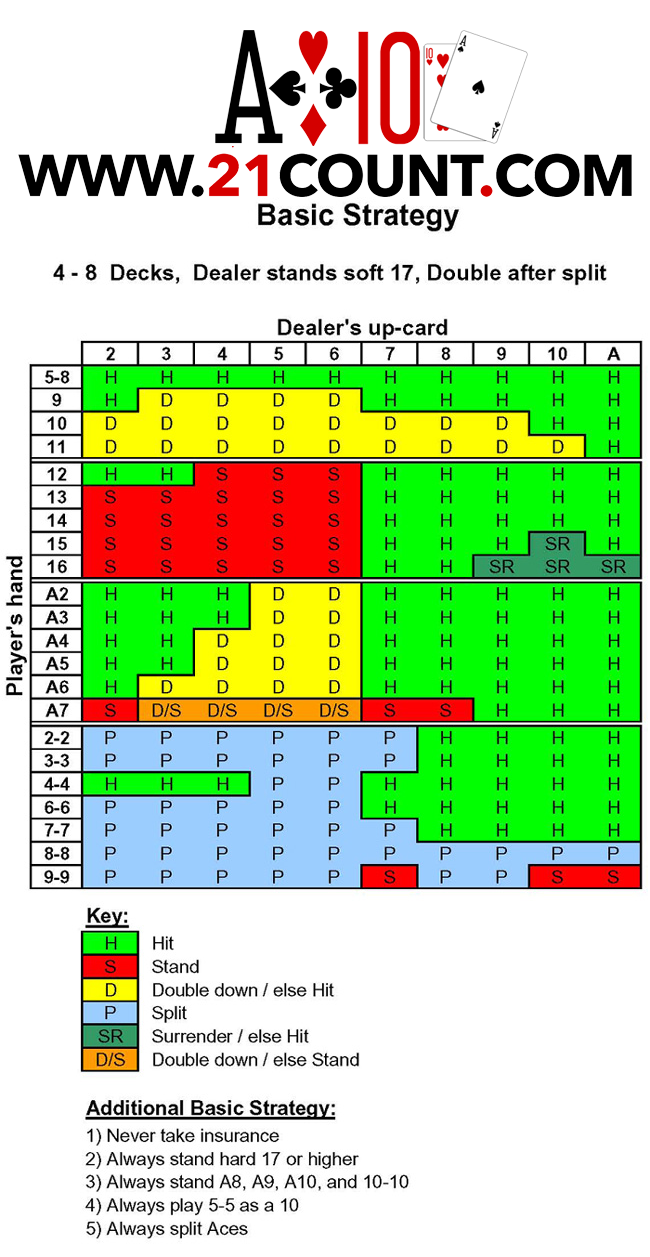
Blackjack basic strategy is the mathematically best way to play every hand: hit, stand, double, split or surrender, based only on your cards and the dealer’s up-card. Played perfectly, it cuts the house edge to roughly 0.5% in a standard 6-deck game. That makes blackjack one of the best-odds games in any casino.
The hard part is not understanding it. It is memorising about 280 decisions and making them without hesitation. That is the gap 21Count.com tries to close. The relaunched site bundles a strategy chart, a hand calculator, a drill trainer, a card counting trainer and a free play-money table in one place, with no sign-up needed.
Quick answer: Learn the chart, check odd hands in a calculator, then drill until every decision takes under three seconds. This guide walks through all three steps, the 10 rules that matter most, and the real odds of winning when you play perfect blackjack strategy.
Top 10 blackjack basic strategy rules
These 10 rules cover most of the money you will win or lose at a blackjack table. They assume the most common casino game: 6 decks, dealer hits soft 17, double after split allowed, late surrender.
- Always split Aces and 8s. Two Aces give you two shots at 21. A pair of 8s is hard 16, the worst total in the game, so splitting escapes it. The one exception: against a dealer Ace, surrender 8s if the table allows it.
- Never split 10s or 5s. A 20 is too strong to break up. A pair of 5s is a hard 10, which you should double instead.
- Double down on 11 against every dealer card. It is the best doubling hand in the game. (At tables where the dealer stands on soft 17, just hit 11 against an Ace.)
- Double 10 against 2 through 9. Hit it against a 10 or an Ace.
- Double 9 against 3 through 6. Otherwise hit.
- Stand on 12 against 4, 5 and 6; hit against 2, 3 and 7 or higher. This is the most misplayed hand in blackjack.
- Stand on 13 to 16 against 2 through 6; hit against 7 or higher. The dealer busts most often with a weak up-card, so let them. Surrender 16 against 9, 10 or Ace, and 15 against 10 or Ace, where allowed.
- Always stand on hard 17 or more. The bust risk outweighs any gain.
- Treat soft hands aggressively. Hit soft 17 or less, and double soft 13 to 17 against the dealer’s weakest cards. Soft 18 is the tricky one: double against 2 to 6, stand against 7 or 8, hit against 9, 10 or Ace.
- Never take insurance. It is a side bet with a house edge of about 7%. Only card counters should consider it.
Once these are automatic, the rest of the blackjack basic strategy chart is detail. Drill the borderline plays (12 vs 2, 16 vs 10, soft 18 vs 9) until you stop second-guessing them.
Blackjack strategy chart: how to read the table
A blackjack strategy chart (also called a strategy table, hand chart or strategy card) puts every decision on one grid. Your hand runs down the left side; the dealer’s up-card, 2 through Ace, runs across the top. The cell where they meet is your move.
21Count’s chart is split into three blocks, which is how every good blackjack hand chart should be read:
- Hard hands (5 to 21, no Ace or an Ace counted as 1). Most hands you play fall here.
- Soft hands (A,2 to A,9, the Ace counted as 11). These cannot bust on one card, so you double and hit more often.
- Pairs, the blackjack split chart. Check this block first whenever you hold two matching cards.
The legend uses the standard codes:
| Code | Meaning |
|---|---|
| H | Hit |
| S | Stand |
| D | Double if allowed, otherwise hit |
| Ds | Double if allowed, otherwise stand |
| P | Split |
| Rh | Surrender if allowed, otherwise hit |
| Rp | Surrender if allowed, otherwise split |
The chart is built for American rules (6 decks, dealer hits soft 17, double after split, late surrender), and there is a downloadable image version you can print as a strategy card. If your casino uses different rules, a handful of cells change. The variants page shows rules and house edge for 12 games, from European and Atlantic City to Spanish 21 and Blackjack Switch.
Blackjack calculator: check any hand in two taps
The free blackjack calculator answers one question fast: what is the right play for this hand against this dealer card? Pick your hand (hard 5 to 21, soft 13 to 20, or any pair), pick the dealer’s up-card, and it returns the best move with a short explanation and the expected value of each option.
That last part is what separates a good blackjack strategy calculator from a chart. Seeing that standing on 16 against a 10 loses slightly more than hitting explains why the chart says hit. It turns rules into understanding, which makes them stick.
It works well on a phone, which makes it handy as a blackjack hand calculator when you are practising at home or playing online. One note on searches like “blackjack cheat calculator”: using any device at a real casino table is banned almost everywhere. Use the calculator to learn, then leave it at home.
Basic strategy trainer: turn the chart into instinct
Reading a chart is not the same as knowing it. 21Count’s strategy trainer deals you random hands and asks for your decision: hit, stand, double, split or surrender. You get instant feedback, an explanation when you are wrong, and accuracy tracking over time.
A sensible routine looks like this:
- Start with hard hands only until you score above 95%.
- Add soft hands, then pairs.
- Spend extra time on the borderline plays you keep missing.
- Push for speed: aim for every decision in under three seconds, the pace of a real table.
When the trainer feels easy, move to the free play-money table. It has a built-in basic strategy coach and a live running count, so you can play full hands and get corrected in real time.
Odds of winning blackjack with basic strategy
With perfect basic strategy you win about 42% of hands, push about 8.5% and lose about 49%. That sounds like a losing game, and it is, slightly. Blackjacks paying 3:2, doubles and splits win you more money on the hands you do win, which closes most of the gap. The result is a house edge of around 0.5%.
| Outcome (per hand, basic strategy) | Probability |
|---|---|
| Player wins | 42.22% |
| Push (tie) | 8.48% |
| Player loses | 49.10% |
| Player is dealt a natural blackjack | 4.75% |
Rules move these numbers. On 21Count’s tables the estimated house edge ranges from about 0.15% for single-deck at 3:2 to about 0.46% for American six-deck. Avoid any table that pays 6:5 on a blackjack; that one rule costs more than all your strategy saves.
Basic strategy vs never bust strategy
The “never bust” blackjack strategy says: never hit a hard 12 or more, and let the dealer bust instead. It feels safe, but it is expensive. Estimates put its house edge at just under 4%, roughly eight times worse than basic strategy. The reason is that the dealer, when showing a 7 or higher, finishes with 17 or more most of the time, so standing on 13 or 14 simply loses.
| Strategy | Approx. house edge |
|---|---|
| Perfect basic strategy | ~0.5% |
| Never bust (stand on hard 12+) | ~3.9% |
Basic strategy keeps the one good idea in never bust, standing on stiff hands against a weak dealer card, and drops the costly part.
Sources: win/push/loss odds, never bust house edge (CAS presentation), never bust myth.
Advanced blackjack strategy: card counting and variants
Basic strategy gets you close to even. Card counting is the only legal way to tip the edge to the player, and it only works once basic strategy is automatic.
The card counting trainer supports seven systems, each with its betting and playing efficiency listed so you can compare them:
| System | Level | Balanced? | Good for |
|---|---|---|---|
| Hi-Lo | 1 | Yes | The default first count |
| KO (Knock-Out) | 1 | No | Skipping true-count maths |
| Red 7 | 1 | No | A simple first count |
| Hi-Opt I | 1 | Yes | Playing decisions |
| Zen Count | 2 | Yes | The usual step up from Hi-Lo |
| Omega II | 2 | Yes | Maximum playing accuracy |
| Hi-Opt II | 2 | Yes | Experienced counters |
Drills cover running count, true count conversion, speed (cards per minute) and deck estimation, over a 1 to 8 deck shoe. The page also lays out an eight-week training plan, from counting a single deck slowly to counting under casino-style distractions.
If you play anywhere other than a standard American table, compare 12 blackjack variants before you sit down. Spanish 21, Blackjack Switch, Double Exposure, Super Fun 21, Pontoon and others each change the strategy, and every one has a free table to practise on.
How to play 21: blackjack hand rules in one minute
If you are brand new, here is how to play 21 with cards:
- Card values. 2 to 10 count at face value. Jack, Queen and King count 10. An Ace counts 1 or 11, whichever helps you.
- The deal. You and the dealer get two cards each. One dealer card is face up (the up-card).
- The goal. Finish closer to 21 than the dealer without going over. Over 21 is a bust, and you lose at once.
- Your options. Hit (take a card), stand (stop), double (double your bet, take exactly one card), split (turn a pair into two hands) or surrender (give up half your bet, where offered).
- The dealer’s turn. The dealer has no choices: they draw until 17 or more. Some tables make the dealer hit soft 17.
- Payouts. A win pays 1:1. A natural blackjack (Ace plus a 10-value card) pays 3:2. A tie is a push and your bet is returned.
The step-by-step tutorial covers all of this with examples. Then you can play free blackjack online with play money to try it out.
Verdict: is 21Count worth using?
Yes, for anyone learning blackjack strategy from scratch or polishing it before a casino trip. The relaunch puts the chart, calculator, trainer and counting drills a click apart, everything is free, and nothing asks for an account or real money.
Pros
- Every tool is free, with no sign-up and play money only
- Calculator shows the expected value of every option, not just the answer
- Seven counting systems with speed, true count and deck estimation drills
- 12 blackjack variants with house edge figures and free tables
- Available in English, Spanish, German, French and Thai
- Works well on mobile
Cons
- The main chart covers one rule set (6 decks, dealer hits soft 17); other rules need the variants page
- The calculator works on hand totals rather than individual cards
- Trainers need JavaScript, so very old browsers will only see the static chart
Blackjack strategy FAQ
What is the best blackjack strategy?
Perfect basic strategy is the best way to play without counting cards. It lowers the house edge to about 0.5% in a standard game. Card counting on top of it is the only legal way to gain an edge.
Is there a perfect blackjack strategy?
“Perfect strategy” usually means basic strategy played without a single mistake. It is the mathematically best play for each hand given the rules, but it cannot guarantee a win in the short run.
What are the odds of winning blackjack with basic strategy?
You win about 42% of hands, push about 8.5% and lose about 49%. Bigger payouts on blackjacks, doubles and splits bring the overall edge close to even.
Does the never bust strategy work?
No. Standing on every hard 12 or more gives the house an edge of roughly 4%, about eight times worse than basic strategy.
Can I use a blackjack strategy card in a casino?
Many casinos allow you to glance at a printed strategy card, but phones and calculators at the table are usually banned. Check the house rules, or simply memorise the chart with a trainer.
How long does it take to learn basic strategy?
Most people learn the core rules in an evening and need one to two weeks of daily drills to play without hesitation.
Is 21Count free?
Yes. All tools are free and use play money only; 21Count does not take real-money bets.
Leave a Reply